Metric vs PG Cable Glands: Which Thread Standard Fits Your Waterproof Connector Project?
Thread Standard Selection Guide
Metric and PG cable glands both seal a cable entry into an enclosure, and both can be supplied with an IP68 rating, but they are not interchangeable thread systems. Metric glands are designated M12 to M63 with a thread outside diameter of 12–63 mm. PG glands are designated PG7 to PG48 with a thread outside diameter of 12.5–59.3 mm. Both families cover a 3–45 mm cable range and a 9–21 mm thread length, which is exactly why cable diameter alone cannot tell you which gland fits. The correct standard is set by three inputs: your panel cutout, your cable outer diameter, and the certification regime of the market you ship into.
The Short Answer: Metric or PG?
Thread standard is a property of the enclosure interface, not of sealing performance. Both series deliver IP68 protection, use the same body and sealing materials, and are certified against the same EU and US document types. What changes is the thread.
- Choose Metric (M) thread for new-design control cabinets, inverters, junction boxes and panels specified to ISO metric dimensions, and for projects that need a documented CE route under EN 62444:2013 or UL coverage for the US and Canadian markets.
- Choose PG thread when you are replacing or extending glands on imported European machinery, older production lines, or panels already punched to PG cutouts, where re-drilling or an adapter would add a joint, cost and risk.
- Choose by market documentation: EU and UK buyers normally need the CE mark with EN 62444:2013 evidence and a RoHS statement; US and Canadian buyers normally need liquid-tight flexible cord fittings covered by a UL 514B document. A CE mark does not replace a UL document.
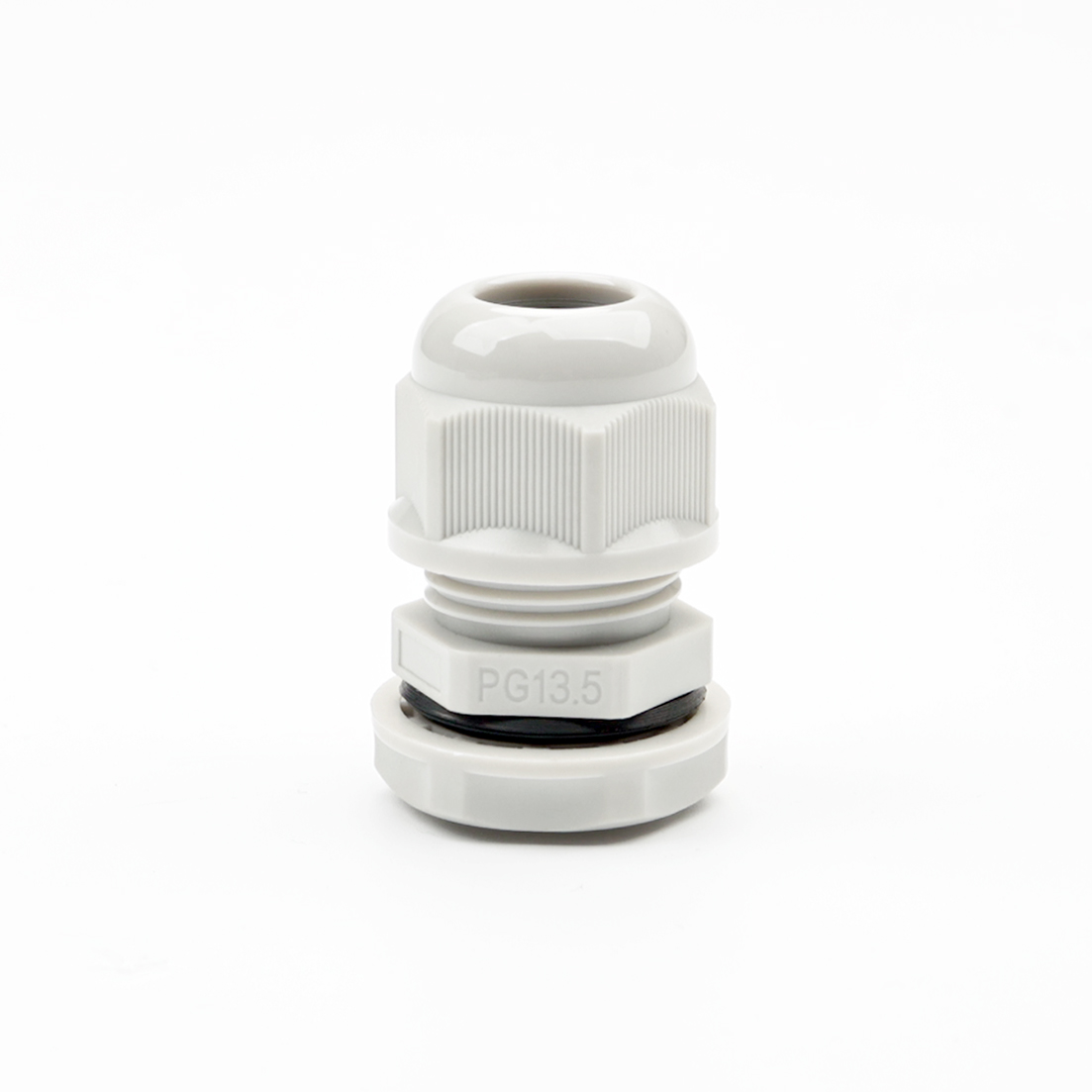
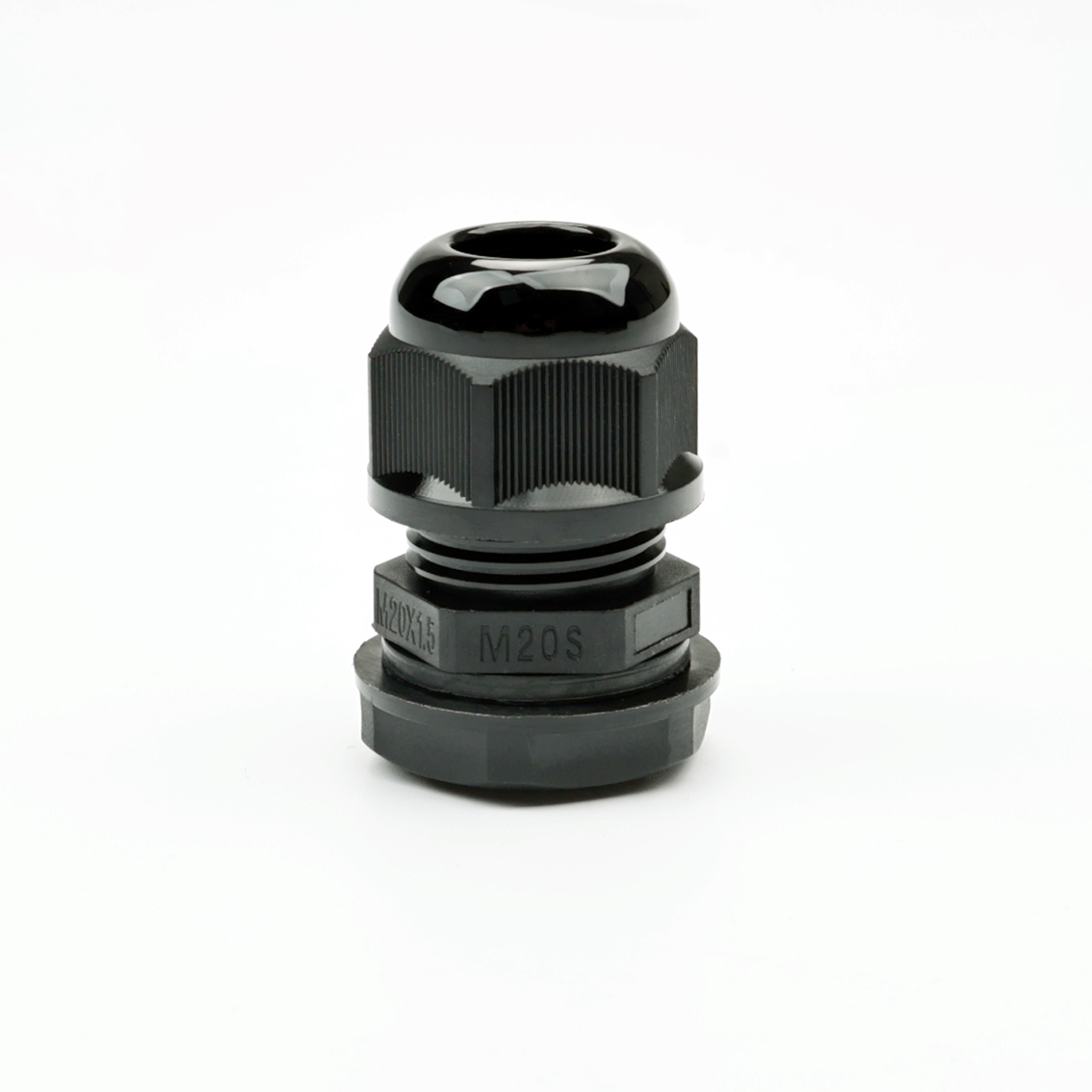
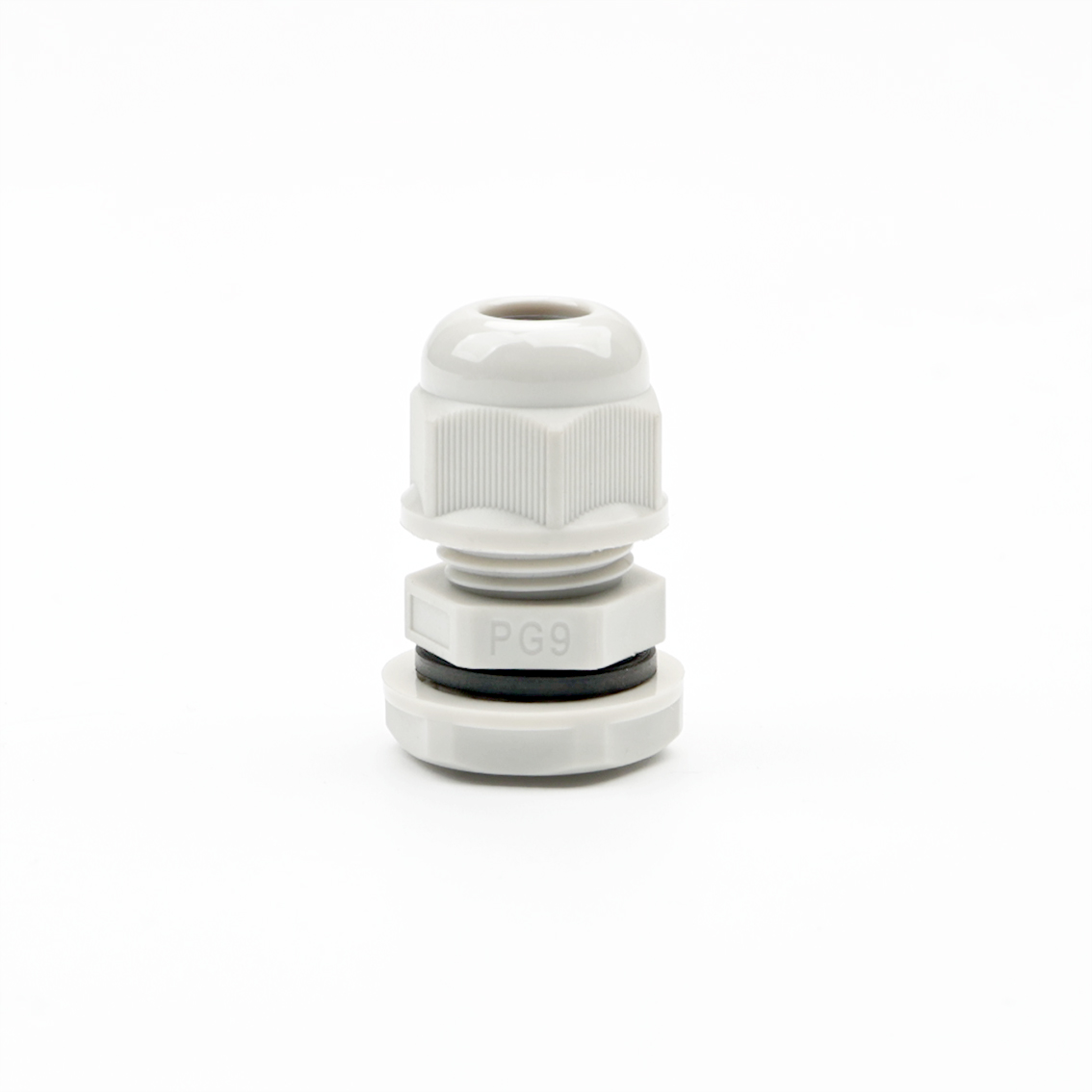
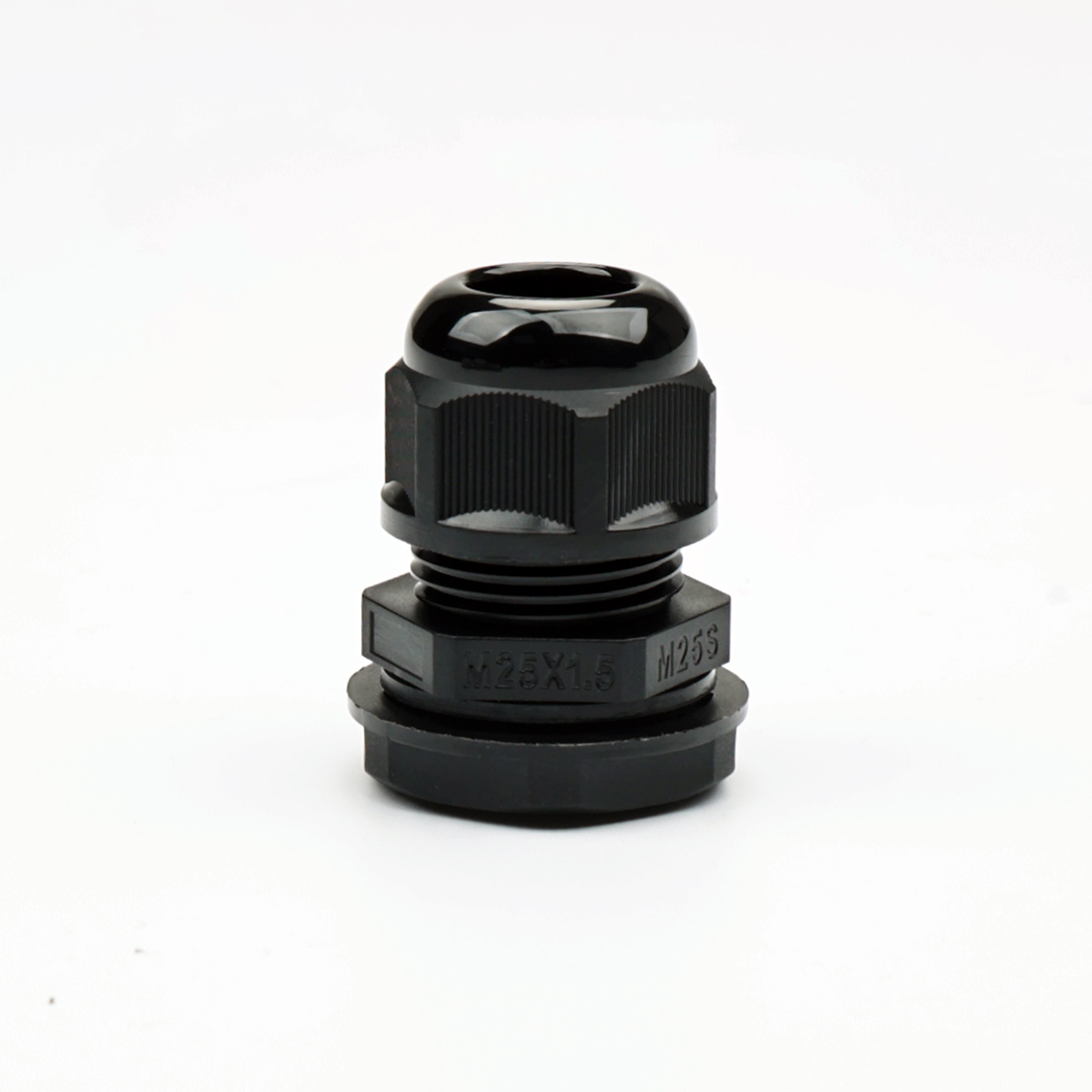
Cable range overlap is what makes this decision harder than it looks. Gutai's cable gland range includes a PG13.5 gland and an M20S gland that both accept 6–12 mm cable, a PG16 gland and an M25S gland that both accept 8.5–14 mm cable, and a PG9 gland and an M16S gland that both accept 4–8 mm cable. The cable fits either way. Only the thread decides whether the gland mounts correctly.
Problem Definition: When the Thread, Not the Cable, Breaks the Project
The most common sourcing error in waterproof connector accessory projects is specifying a cable gland by cable range only. Because both the Metric and the PG series span a 3–45 mm cable range, overlapping sizes exist at almost every step, and a purchase order that lists only “6–12 mm” does not define a mountable part. Three failure modes follow.
1. Cutout mismatch
A gland seals through two interfaces: the thread grips the panel cutout, and a sealing washer or O-ring is compressed against the panel face by the nut. When the cutout does not match the thread outside diameter, buyers typically ream or drill the opening in the field. That changes the cutout geometry, and the sealing interface is no longer the one the gland was designed against. Thread adapters solve the mechanical problem but add a threaded joint, which is an additional assembly step and an additional path to manage in inspection.
2. Thread length shorter than the wall stack
Both series are made with a thread length of 9–21 mm. On a thick enclosure wall, a thick mounting plate, or a wall plus an internal bracket, a gland whose thread length is shorter than the total stack cannot be fully secured by the supplied nut. This is a dimensional check, not a preference, and it should be made against the real panel drawing before a standard is locked.
3. Compliance mismatch between the design standard and the destination market
A project engineered in Europe and shipped to North America can pass the electrical design review and still be rejected at incoming inspection because the documentation set does not match the market. The EU route and the US route rely on different documents. EN 62444:2013 is the European standard for cable glands, and it superseded the older BS EN 50262. In the US and Canada, the relevant document for liquid-tight flexible cord fittings is issued under UL 514B. Projects that ship to both regions normally need both document sets, and the thread standard chosen for a panel is often the point where the two documentation paths diverge.
Industry Background: Two Thread Legacies, One Market
The cable gland market continues to grow because cable entries exist in every electrified enclosure, and both thread standards remain in active production because of the installed base they serve. Published third-party estimates put the global cable glands market at approximately USD 2.16 billion to 2.25 billion in 2024–2025, with growth forecasts ranging between USD 3.07 billion and USD 4.96 billion by 2034 (Straits Research and Spherical Insights). Asia Pacific is the leading regional market, accounting for roughly 38–42% of global revenue, driven primarily by industrialisation in China and India (Dataintelo and Straits Research). The wider waterproof connector market, which includes connectors and accessories beyond glands, was valued at approximately USD 13.4 billion in 2024 and is projected to reach USD 25.48 billion by 2033 at a CAGR of 7.4%.
Standards shape how that demand is documented. IEC 62444, and its European adoption EN 62444, governs the construction and performance requirements for cable glands used in electrical installations. IP68, defined under IEC 60529, is the ingress protection benchmark that waterproof cable glands and connectors are usually specified against, requiring the device to withstand continuous immersion in water under specified conditions.
The supply side is a mix of large multinational component groups and regional manufacturers. Leading global competitors in the cable gland and connector sector include ABB Ltd., Eaton Corporation, Amphenol Corporation, LAPP Group and HUMMEL AG. Those suppliers and their regional counterparts continue to support PG thread because a large installed base of imported European machinery, tooling and existing panel designs was built on it, while new equipment designs increasingly default to ISO metric threads.
Zhejiang Gutai Connector Co., Ltd. (Gutai) is a manufacturer of waterproof cable glands and connector accessories based in Qianzhou Industrial Zone, Liushi Town, Yueqing City, Wenzhou, Zhejiang, China. The company produces nylon cable glands in Metric and PG thread forms, together with EMC and porous cable glands, brass screw caps, watertight corrugated tubing fittings, Solar MC4 connectors and mini waterproof boxes and connectors. Its 5,000 m² facility employs 80 people, including a 10-engineer R&D team, and exports approximately 80% of output to markets that include the Middle East, Southeast Asia, India, Pakistan, the EU, the United Kingdom and the USA. Cable gland production capacity is 500,000 pcs per month, with Solar MC4 connector capacity at 100,000 sets per month.
Detailed Solution: Matching Parameters That Decide Fit
Metric and PG cable glands are compared below on the parameters that actually change a purchase order: thread designation, thread outside diameter, thread length, cable range, thread type availability, material construction, protection rating, and certification documents.
Thread size ranges: M12–M63 versus PG7–PG48
The Metric series is produced in thread sizes from M12 to M63. The PG series is produced in thread sizes from PG7 to PG48. The two scales both end near the same maximum cable capacity, so the two series are functionally comparable across the whole size ladder; the difference is which designation a panel drawing uses. A specification written around M-size cutouts and a specification written around PG cutouts will produce the same sealing result if the correct size is chosen in each.
Thread outside diameter and panel cutout: 12–63 mm versus 12.5–59.3 mm
The Metric series spans a thread outside diameter of 12–63 mm. The PG series spans 12.5–59.3 mm. The outer limits are close, but they are not identical at the small end either: the smallest Metric thread in the range is 12 mm, while the smallest PG thread is 12.5 mm. Because the designations do not map one-to-one, a panel cutout must be matched against the actual thread outside diameter of the part number, not against a similarly numbered or similarly ranged gland of the other standard. For a first-pass drawing check, the cutout should clear the thread outside diameter and remain concentric with the sealing face.
Thread length: 9–21 mm in both series
Thread length is 9–21 mm in the Metric series and 9–21 mm in the PG series. Smaller sizes sit at the lower end of that band and larger sizes at the upper end. When a project uses thick enclosure walls, mounting plates or standoff brackets, the selected size must have enough thread length to pass through the full stack and still accept the nut with a complete thread engagement.
Cable range: 3–45 mm in both series
Both series accept a 3–45 mm cable range. The clamping structure uses a special clamping claw combined with a rubber sealing element, which gives a wide clamping range per size and good pull-out resistance. Two consequences matter for buyers. First, each individual size covers a band, not a single cable diameter, so the same gland can serve several cable types on one panel — provided the thread is correct. Second, because both standards cover the same total cable range, cable range is a size selector within a standard, not a selector between standards.
Thread type availability: Metric, PG, G and NPT
Gutai produces four mainstream thread types in the same product family: Metric, PG, G thread and NPT thread. Practically, this means a buyer can consolidate a multi-market bill of materials with one supplier while keeping the thread interface that each panel requires: Metric for ISO-metric panels, PG for legacy European equipment, G thread for parallel pipe-thread entries, and NPT for tapered pipe-thread entries.
Material and sealing construction: Nylon PA66 and NBR
Both the Metric and PG series use Nylon PA66 for components A, C, E and F and NBR nitrile butadiene rubber for the sealing components B and D. The Nylon PA66 is UL approved. PA66 provides high strength and anti-ageing performance, while NBR is selected for reliable sealing and oil resistance. Standard colours are Black (RAL9005), Light Grey (RAL7035) and Silver (RAL7001), with custom colours available on request. In practice, material and thread standard are independent decisions: choosing PG thread does not reduce the material specification, and choosing Metric thread does not automatically raise it.
Protection and temperature ratings
Both series are IP68 rated for waterproof and dustproof performance. Operating temperature ranges are identical across the two thread standards: in static conditions, -40 °C to 100 °C with a peak instantaneous temperature up to 120 °C; in dynamic conditions, -20 °C to 80 °C with a peak instantaneous temperature up to 100 °C. The glands are also resistant to salt spray, acid, alkali, alcohol, grease and common solvents, which matters in marine engineering, shipbuilding, outdoor energy equipment and coastal installations.
Certification documents that matter by market
Compliance is the parameter most often misread, because a product can carry several marks and still not satisfy a specific market. The documents attached to these cable glands are:
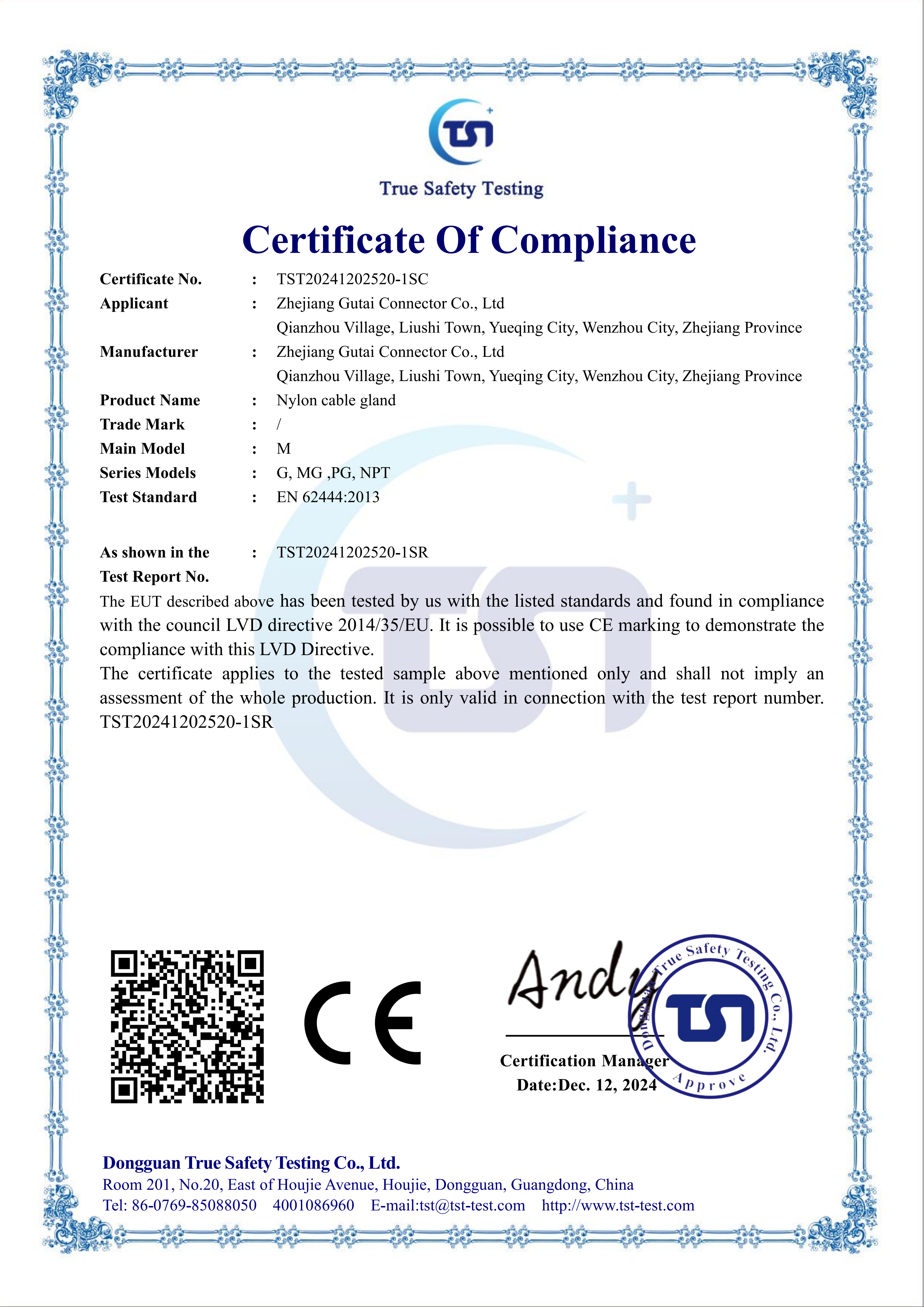
- CE (EU): Certificate of Compliance number TST20241202520-1SC, issued by Dongguan True Safety Testing Co., Ltd., certified to EN 62444:2013. The certified scope is nylon cable glands, Model M, Series G, MG, PG and NPT. Issue date: 2024-12-12.
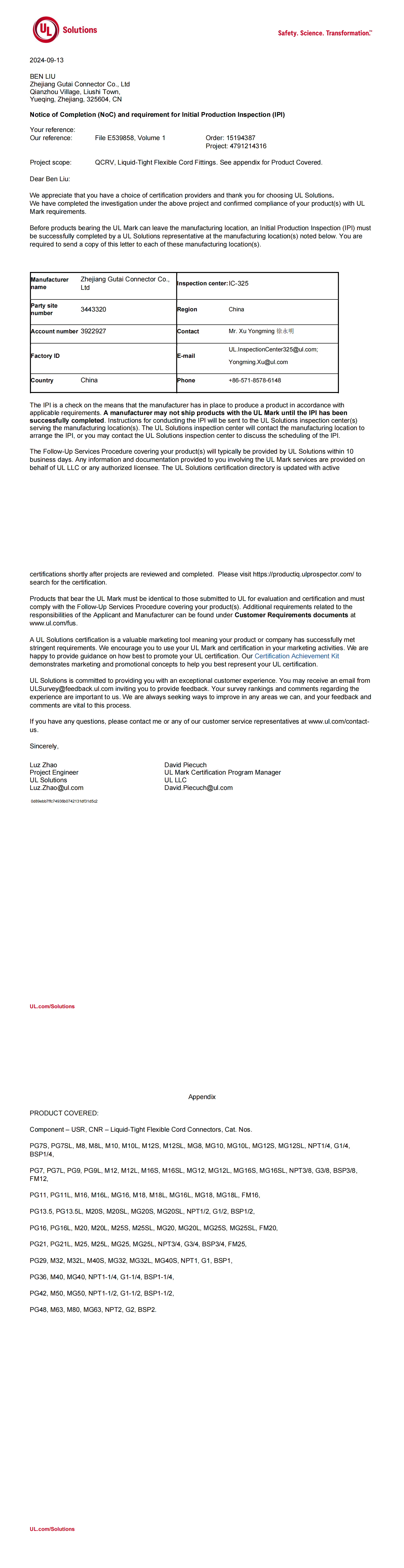
- UL (US and Canada, and global): Notice of Completion (NoC) for QCRV Liquid-Tight Flexible Cord Fittings, File E539858, Volume 1, issued by UL Solutions against UL 514B. The document was issued on 2024-09-13 and lists the full catalog numbers in its appendix. Gutai records this document against its Metric Series cable glands, applicable to the US and Canadian markets (order 15194367, project 4791214316), and against its PG model.
- Quality management system: ISO9001:2015, Registration No. 04324Q31620R0S, issued by Beijing United Intelligence Certification Co., Ltd. against GB/T19001-2016 / ISO9001:2015. The scope covers the production of cable waterproof joints; issue date 2024-07-02, valid to 2027-07-01.
- RoHS (EU): SGS test report number NGBEC26005747401, issued by SGS-CSTC Standards Technical Services (Ningbo) Co., Ltd. against the EU RoHS Directive (EU) 2015/863 amending Annex II to Directive 2011/65/EU, with the tested scope given as “NYLON CABLE GLAND”. Issue date: 2026-07-13.
- Material approval: the Nylon PA66 used in these cable glands is UL approved, supporting EU and US export documentation for the finished product.
The products are additionally listed with CE, RoHS, REACH, IP68 and CCC certification. Because the UL document covers QCRV liquid-tight flexible cord fittings, buyers who need to cite it should confirm that the specific catalog number they are ordering appears in the file's appendix — this is a normal documentation step, and it prevents a project from reaching incoming inspection with an unlisted part number.
Large-size options in both standards
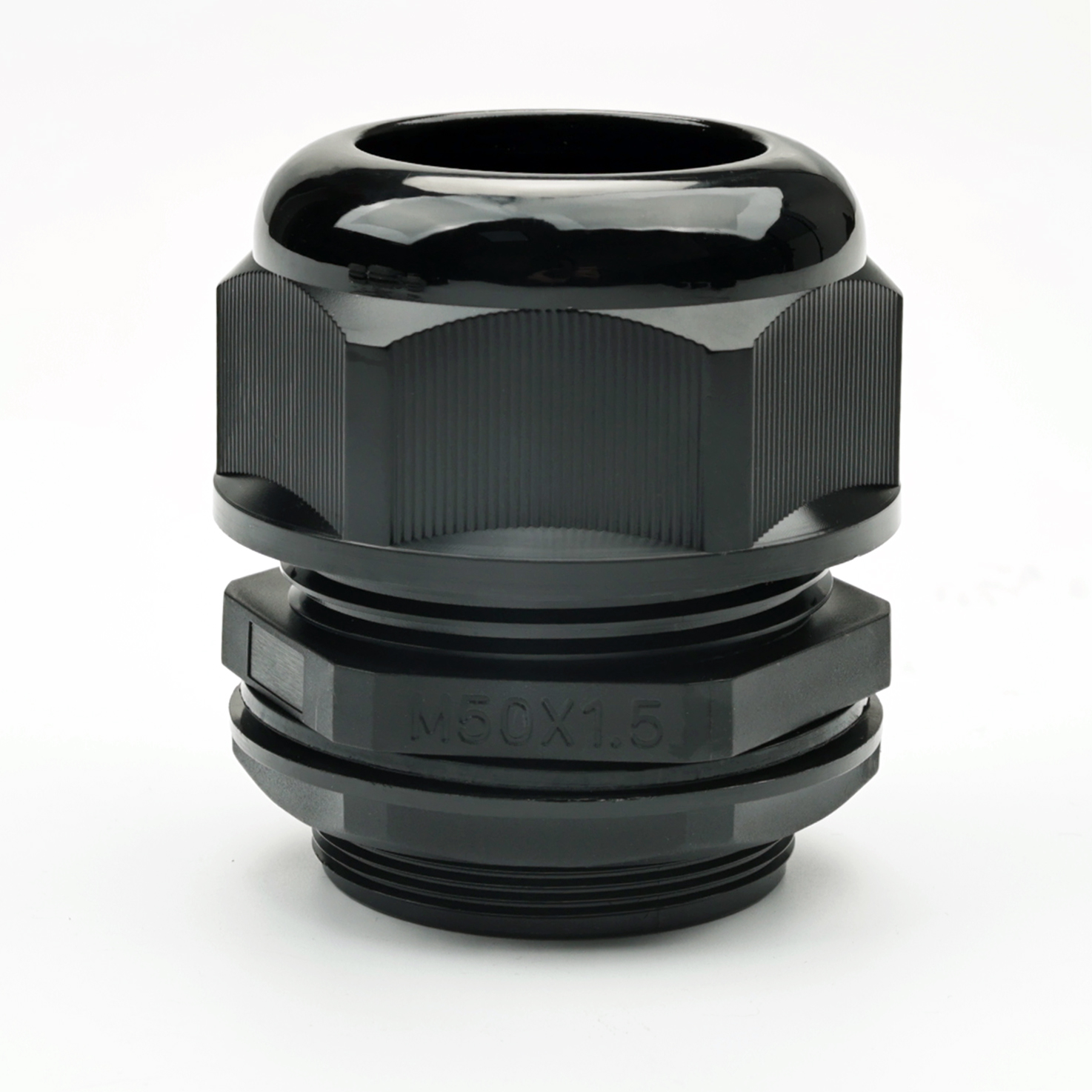
Both standards extend to large cable entries. Metric sizes reach M50 with a 31–41 mm cable range and M63 with a 35–45 mm range. PG sizes reach PG42 with a 31–41 mm range and PG48 with a 35–45 mm range. Panels that mix both standards at the large end usually reflect an existing enclosure layout rather than a technical preference, and both can be supplied from the same production line and under the same certification set.
Step-by-Step: Selecting the Thread Standard for Your Project
- Identify the thread on the existing panel or equipment. If the equipment came from a European machine builder or already has glands fitted, read the thread designation from the existing gland or the panel drawing. Replacement should match the installed standard, because the cutout already exists.
- Measure the panel cutout and the wall stack. Record the cutout diameter and the total thickness through which the thread must pass. Check both against the thread outside diameter (Metric 12–63 mm, PG 12.5–59.3 mm) and the thread length (9–21 mm in both series).
- Measure the cable outer diameter, then select the size. Pick the gland size whose cable range covers the measured diameter, using the intended size series. A 6–12 mm cable can be served by PG13.5 or M20S, and an 8.5–14 mm cable by PG16 or M25S; the size choice depends on the thread standard you confirmed in steps 1 and 2.
- Confirm the environment and the required protection. For outdoor, marine, coastal or washdown conditions, specify IP68 and check the temperature range against the application: static -40 °C to 100 °C (peak 120 °C) or dynamic -20 °C to 80 °C (peak 100 °C). Resistance to salt spray, acid, alkali, alcohol, grease and common solvents should be part of the requirement where relevant.
- Match the documentation to the destination market. For EU and UK shipments, request the CE certificate to EN 62444:2013 and the RoHS test report. For US and Canadian shipments, request the UL 514B Notice of Completion and verify the catalog number appears in the appendix. ISO9001:2015 applies globally and covers the production of cable waterproof joints.
- Validate with a sample before locking production. Small trial orders are acceptable, and every unit passes 100% full dimension inspection. A sample check confirms thread fit, cable clamping range and sealing on the actual panel before volume production.
Use Cases: Which Standard Wins in Practice
Retrofitting imported European machinery
When a production line built in Europe is relocated or expanded, the panel cutouts are already PG. Matching the existing PG thread removes the need for adapters and re-drilling, and it keeps the retrofit within the original enclosure design. This is the clearest case where PG thread is the correct technical answer rather than a legacy compromise.
New-build control cabinets and inverter enclosures for the EU market
For new designs, metric thread is the default and the documentation is straightforward: M-size cutouts, CE to EN 62444:2013, RoHS test report for the nylon cable gland, and ISO9001:2015 as the quality system behind production. A typical specification will use M20 and M25 as the primary working sizes, with M12 and M16 for control and signal cables and M32 to M63 for larger power feeders.
North American panels and enclosures
Panels destined for the US or Canada require the UL documentation route. The relevant document for these products is the Notice of Completion for QCRV liquid-tight flexible cord fittings under UL 514B, File E539858, Volume 1, issued by UL Solutions. Because the document references an appendix of catalog numbers, the part number should be verified against the file as part of the purchase process.
Outdoor, coastal and high-corrosion projects
Thread standard and environmental performance are decided separately, and high-corrosion projects show why the second decision deserves its own review. In a European coastal open-air EV charging project, 5,000 sets of IP68-grade metal waterproof connectors using 304 stainless steel and a dual-seal anti-loosening structure were deployed for DC fast-charging piles. The connectors passed 1,000-hour salt spray testing and IEC 60068-2-6 vibration testing; the connector-related electrical failure rate fell from 18% annually to 2.6%, and annual maintenance cost per station dropped from over 500 RMB to below 80 RMB, with installation efficiency up 35%. In that project the thread standard was fixed by the charging pile enclosure design, while the winning specification work sat in materials, sealing structure and test evidence.
Comparison Table: Metric vs PG Cable Glands at a Glance
| Selection parameter | Metric cable gland (M series) | PG cable gland (PG series) |
|---|---|---|
| Thread designation range | M12–M63 | PG7–PG48 |
| Thread outside diameter | 12–63 mm | 12.5–59.3 mm |
| Thread length | 9–21 mm | 9–21 mm |
| Cable range | 3–45 mm | 3–45 mm |
| Thread types available in the same family | Metric, PG, G thread, NPT thread | Metric, PG, G thread, NPT thread |
| Body components A/C/E/F | UL-approved Nylon PA66 | UL-approved Nylon PA66 |
| Sealing components B/D | NBR nitrile butadiene rubber | NBR nitrile butadiene rubber |
| Ingress protection | IP68 | IP68 |
| Static temperature | -40 °C to 100 °C, peak 120 °C | Same as Metric series |
| Dynamic temperature | -20 °C to 80 °C, peak 100 °C | Same as Metric series |
| Standard colours | Black RAL9005, Light Grey RAL7035, Silver RAL7001; custom colours on request | Same as Metric series |
| EU compliance | CE to EN 62444:2013, certificate TST20241202520-1SC (series G, MG, PG, NPT); RoHS, REACH, IP68, CCC | CE to EN 62444:2013, certificate TST20241202520-1SC; RoHS, REACH, IP68, CCC |
| US / Canada document | UL Notice of Completion, File E539858, Volume 1, UL 514B — Metric Series, US and Canadian markets | UL Notice of Completion, File E539858, Volume 1, UL 514B — PG model |
| Quality management system | ISO9001:2015, Registration No. 04324Q31620R0S | Same as Metric series |
| Typical best fit | New ISO-metric panel designs; projects requiring documented CE or UL coverage | Existing PG cutouts, imported European machinery, retrofit and replacement work |
FAQ: Metric vs PG Cable Glands
Are both the Metric and PG cable glands covered by UL and CE documentation?
Yes. Gutai holds a CE Certificate of Compliance, number TST20241202520-1SC, issued by Dongguan True Safety Testing Co., Ltd. and certified to EN 62444:2013, with a scope covering nylon cable glands, Model M, Series G, MG, PG and NPT. For North America, the relevant document is a UL Notice of Completion (NoC) for QCRV Liquid-Tight Flexible Cord Fittings, File E539858, Volume 1, issued by UL Solutions against UL 514B; Gutai records this document against its Metric Series cable glands for the US and Canadian markets (order 15194367) and against its PG model. The products are additionally listed with CE, RoHS, REACH, IP68 and CCC certification, and production runs under an ISO9001:2015 quality management system, Registration No. 04324Q31620R0S. Because the UL document lists catalog numbers in an appendix, buyers should confirm the exact part number they plan to order appears in the file.
Can I source both thread standards from one supplier, and what other thread types are available?
Gutai produces the Metric series from M12 to M63 and the PG series from PG7 to PG48, and both are available in four mainstream thread types: Metric, PG, G thread and NPT thread. Both series share the same 3–45 mm cable range and 9–21 mm thread length, use UL-approved Nylon PA66 for components A, C, E and F and NBR for sealing components B and D, and are IP68 rated. Cable gland capacity is 500,000 pcs per month, with Solar MC4 connector capacity at 100,000 sets per month. OEM and ODM customisation covers size and thread specifications, materials including nylon, brass and stainless steel, colour, packaging and OEM labelling, multi-hole layouts, and specific seal customisations.
How is pricing structured across the Metric and PG ranges?
Gutai does not publish a single price band for cable glands, because the two series together span M12–M63 and PG7–PG48 with several material, colour and sealing configurations. Pricing is quoted per project against a confirmed thread standard, thread size, cable range, material, colour and order quantity. For buyers comparing the two standards commercially, the practical approach is to fix the technical specification first — thread, size, cable range, protection rating and market documentation — and then request comparable quotes for the two candidate part numbers. Small trial orders are accepted, which separates the cost of validating a thread standard from the cost of a production run.
Can I validate a Metric or PG gland before committing to a volume order?
Yes. Small trial orders are acceptable, and Gutai applies 100% full dimension inspection to production. A sample validation should confirm three things on your own panel: that the thread engages the existing or planned cutout, that the cable sits inside the stated clamping range with the correct sealing compression, and that the required certification document lists the part number you intend to order. Returns and refunds without reason are available for quality-related problems.
What lead time and order quantity should I plan for?
Lead time is based on your order quantities, and small trial orders are acceptable, so the sequence most buyers use is a sample order first, then a volume schedule matched to the production plan. Because cable gland capacity is 500,000 pcs per month and Solar MC4 connector capacity is 100,000 sets per month, mixed orders that combine glands, MC4 connectors and waterproof boxes can be scheduled together. If you want to move from evaluation to a confirmed plan, send the thread standard, size, cable range, colour and destination market, and request a sample or a quotation — the Gutai team will confirm the part number, the applicable certification document and the delivery schedule in one response.
Conclusion
Metric and PG cable glands are not competing levels of quality; they are two thread interfaces serving two different installed bases. Metric thread (M12–M63, 12–63 mm thread outside diameter) is the standard for new ISO-metric panel designs and for projects that need a clean documentation path into the EU and North American markets. PG thread (PG7–PG48, 12.5–59.3 mm thread outside diameter) remains the correct choice wherever a cutout already exists, particularly on imported European machinery and retrofit work. Both share a 3–45 mm cable range and a 9–21 mm thread length, use UL-approved Nylon PA66 with NBR sealing, are IP68 rated, and are supported by CE certification to EN 62444:2013, a UL 514B Notice of Completion under File E539858, an ISO9001:2015 quality system and an SGS RoHS test report.
The decision procedure is short: read the thread on the panel, measure the cutout and the wall stack, measure the cable, check the environment, match the documents to the destination market, then validate with a sample. If you are still deciding between the two standards for a specific project, a sample and a documented quote will settle the question faster than any catalogue comparison.
Request a sample, a quotation or the full catalogue
Tell us the thread standard, thread size, cable range, colour and destination market, and we will confirm the matching part number and the applicable certification document — Metric (M12–M63), PG (PG7–PG48), G thread or NPT.
Zhejiang Gutai Connector Co., Ltd.
Website: www.gt-connector.com
Product catalogue (PDF): Gutai 2025 catalogue download
Contact: Vincy Wang — vincy@gt-connector.com — Tel / WhatsApp: 0086-13676576672
Address: Qianzhou Industrial Zone, Liushi Town, Yueqing City, Wenzhou, Zhejiang, China
Small trial orders are acceptable. 100% full dimension inspection. Returns and refunds without reason are available for quality-related problems.
Have Questions or Need More Details?
Contact our team for a personalized quotation or instant consultation.
Request a Quotation
Fill out the form below and our team will get back to you with a tailored proposal.
WhatsApp Direct Chat
Prefer to chat in real-time? Message us on WhatsApp for instant assistance & quick answers.
- Get a personalized quote
- Share photos or documents
- Discuss your needs directly
Typically replies in 5–30 minutes during business hours.