How Clamping Claws and Rubber Seals Make Nylon Cable Glands IP68
IP68 protection in a nylon cable gland is produced by two small components working as a pair: a segmented clamping claw that grips the cable jacket, and an NBR rubber seal that is compressed around that same jacket. The Nylon PA66 body supplies the thread, the compression seat and the dielectric frame, but it seals nothing on its own. If the claw is matched to the wrong cable diameter, or the seal is not compressed to the right degree, the gland will leak even though the housing is intact and the datasheet says IP68.
Understanding this mechanism changes both how a buyer specifies a gland and how an installer tightens it. It also explains why two glands with identical thread sizes behave very differently on the same cable. The construction described in this article is that of Gutai nylon cable glands — Metric M12–M63 and PG7–PG48 series, cable range 3–45 mm, Nylon PA66 body with NBR sealing — produced by Zhejiang Gutai Connector Co., Ltd., a manufacturer based in Wenzhou, China, that specialises in waterproof cable glands, solar MC4 connectors and watertight conduit fittings.
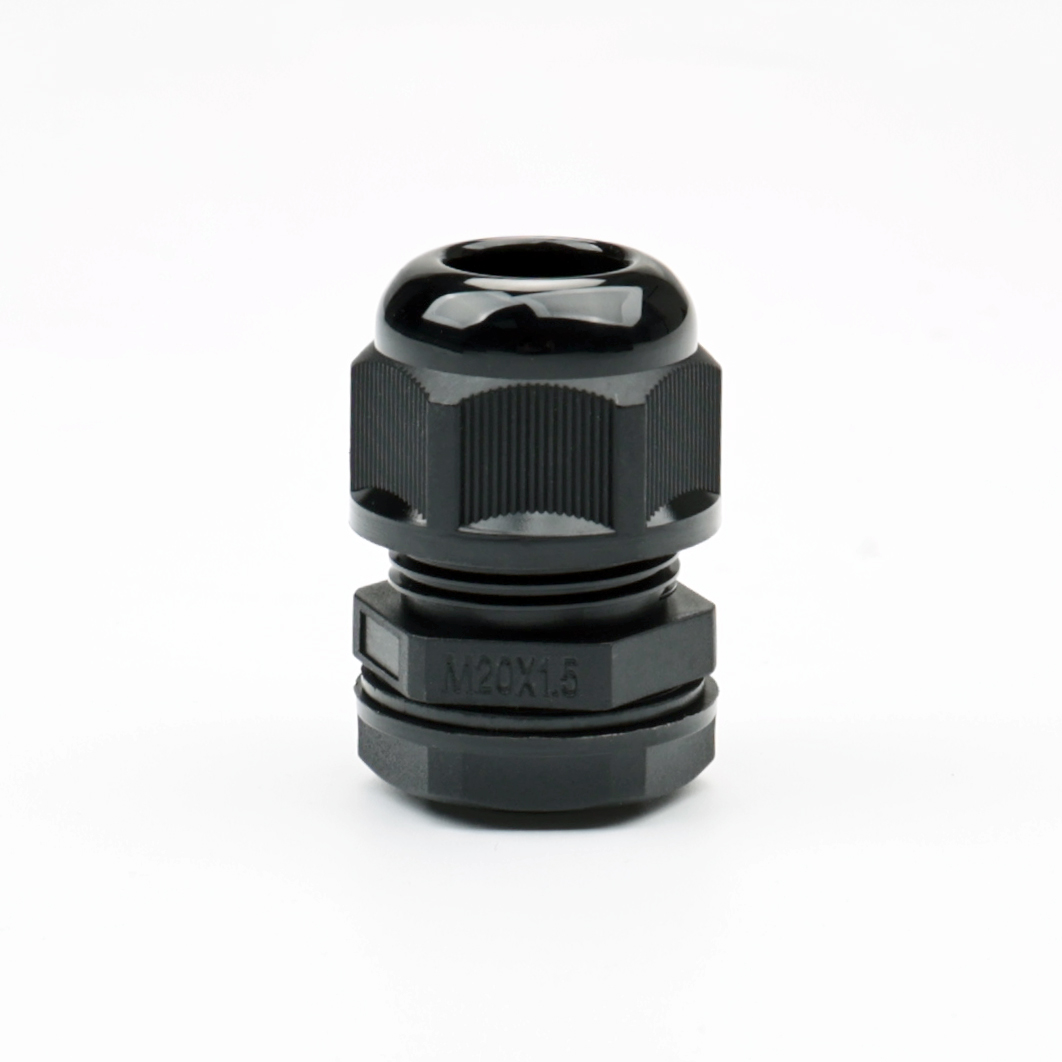
A nylon cable gland of the type discussed here: PA66 body, segmented clamping claw under the sealing nut, NBR seal below it.
Why Cable Glands Rated IP68 Still Leak
Field leaks rarely start with a cracked housing. They start on the load path or on the compression path, and both of those paths run through the claw and the seal.
Failure path 1: the cable is not mechanically anchored
When a cable is pulled, twisted or vibrated and the claw does not grip it, that movement is transferred downstream to the seal and to the terminal block. A seal that is repeatedly worked against a moving jacket will polish and abrade the jacket surface, and abrasion opens a capillary path along the cable — water then travels inside the gland rather than through it. This is why strain relief is a sealing function, not a separate mechanical convenience.
Failure path 2: the seal is compressed to the wrong degree
Under-compression happens when the cable sits below the effective working window of the gland, or when the sealing nut is only hand-tightened. The elastomer never reaches the radial expansion needed to close the annular gap, and the joint weeps under spray or immersion. Over-compression happens when an oversized cable is forced in, or when the nut is tightened beyond the point where the claw stops moving. NBR that is compressed past its elastic limit takes a permanent set, loses rebound, and will not re-seal after the first thermal cycle.
Failure path 3: the leak is at the enclosure interface
A gland can seal perfectly against the cable and still leak at the port. Thread engagement, port flatness, thread damage and insufficient insertion depth all create a water path around the thread rather than around the cable. In that case the claw and the seal are functioning correctly and the fault lies elsewhere in the assembly.
IP68 is defined in IEC 60529 as protection against continuous immersion in water under conditions agreed between manufacturer and user. It is therefore a property of the assembled system — gland, cable jacket and enclosure — not of the gland in isolation. That is why the claw and seal must be specified against the measured cable diameter rather than against the thread size alone.
The Standards and Market Context Behind the Mechanism
Two reference points frame how these components are judged. IEC 62444, and its European adoption EN 62444, sets the construction and performance requirements for cable glands used in electrical installations and replaced the older BS EN 50262. Gutai's CE Certificate of Compliance TST20241202520-1SC, issued on 12 December 2024 by Dongguan True Safety Testing Co., Ltd., cites EN 62444:2013 and covers nylon cable glands, model M, in the G, MG, PG and NPT series. The second reference point is IEC 60529 itself: the ingress protection claim is only meaningful when the immersion conditions and the cable used in the test are known.
The commercial context explains why this level of detail now matters to buyers. The global cable glands market was valued at approximately USD 2.16 billion to 2.25 billion in 2024–2025, with growth forecasts varying between USD 3.07 billion and USD 4.96 billion by 2034 (Straits Research / Spherical Insights). Asia Pacific accounts for an estimated 38% to 42% of global revenue, driven mainly by industrialisation in China and India (Dataintelo / Straits Research). The wider waterproof connector market was valued at about USD 13.4 billion in 2024 and is projected to reach USD 25.48 billion by 2033 at a CAGR of 7.4% (AOHUA / Industry Intelligence). Published estimates differ by methodology and scope, so ranges are more reliable than single-point figures.
As volumes grow in outdoor, marine and industrial enclosure work, the specification that separates one gland from another shifts away from the IP68 label — which nearly every supplier prints — and towards the geometry that actually produces the seal: claw finger design, seal thickness, bore tolerance and thread engagement.
The Mechanism, Component by Component
The PA66 housing: thread, seat and dielectric frame
Nylon PA66 (polyamide 66) is used for the gland body because it combines mechanical stiffness with electrical insulation and chemical resistance. In Gutai's nylon series the body carries four functional features:
- the enclosure thread — Metric M12–M63 with a thread outside diameter of 12–63 mm, or PG7–PG48 with a thread outside diameter of 12.5–59.3 mm;
- a thread length of 9–21 mm depending on size, which sets how deeply the gland engages the enclosure wall;
- the conical seat against which the clamping claw closes;
- the through-bore for the cable and the seat that locates the NBR seal.
The PA66 and NBR assembly is specified for resistance to salt spray, acids, alkalis, alcohol, grease and solvents. Operating temperature is −20 °C to 80 °C in dynamic applications and −40 °C to 100 °C in static applications; the dynamic figure applies to a cable that moves or flexes after installation, the static figure to a cable that is fixed in place.
The clamping claw: turning tightening torque into grip
The claw is a segmented collar that sits inside the sealing nut, with its fingers riding on the conical seat machined into the body. Turning the sealing nut drives the fingers inward and forward simultaneously, so a rotational input becomes an even radial clamping force distributed around the circumference of the jacket. Three properties follow from that geometry:
- Uniform load distribution. Because the force is shared across several fingers instead of one point, local jacket deformation stays small and the seal beneath the claw is not distorted into an oval.
- Pull-out and torsion resistance. The claw anchors the cable before any load reaches the terminals or the seal. That anchoring is what strain relief means in practice, and it protects the conductor terminations as much as the seal.
- Progressive closure across a wide range. The series as a whole covers a 3–45 mm cable range; each thread size has its own working window inside that range, and a cable sitting at the extreme edge of a window is a sealing risk even when it is nominally within specification.
The NBR rubber seal: turning axial compression into a radial barrier
The seal is an NBR (nitrile butadiene rubber) ring or insert located between the claw and the body seat. When the sealing nut is tightened, the claw pushes the seal axially against its seat. Because an elastomer cannot compress in volume, it expands radially onto the cable jacket and closes the annular gap between jacket and bore. NBR is chosen for this position because it retains elasticity in the presence of oils, greases and fuels — the media most likely to reach a gland in machinery, instrumentation and cabinet applications — and because it keeps its rebound across the specified temperature window rather than hardening and losing contact pressure.
Why the pair works and neither part works alone
Separating the two functions makes the logic clear:
- Without the claw, the seal would absorb the mechanical load. It would be worked by every movement of the cable, would abrade the jacket, and would eventually leak.
- Without the seal, the claw would grip firmly and water would still pass through the annular gap between jacket and bore.
- With both, movement is stopped upstream of the seal and water is stopped downstream of the claw. The PA66 body maintains the compression that keeps both conditions true over the service life of the installation.
This is also the reason a single-elastomer design that tries to perform both jobs is more sensitive to cable tolerance: the same element cannot be both soft enough to seal and hard enough to anchor.
From Loose Parts to an IP68 Joint: Six Steps
- Measure the jacket, not the conductor. Use a caliper on the cable jacket at the point where it will sit under the seal, and confirm it falls inside the working window of the chosen thread size. The series covers 3–45 mm in total, but each size covers a narrower band.
- Disassemble in order and thread the parts onto the cable first. Sealing nut, then claw, then seal, then body. Assembling in the reverse order is a common cause of a seal that is pinched on one side.
- Seat the body in the enclosure. Thread length is 9–21 mm depending on size, so confirm full engagement rather than partial turns. Check the port for thread damage and confirm the mating surface is flat before tightening.
- Insert the cable to the correct depth. Enough jacket should enter the enclosure that the conductors are not under tension, and the jacket must extend past the seal seat, not stop short of it.
- Close the claw, then compress the seal. Hand-tighten until resistance rises, then finish with a wrench until the claw stops advancing. The correct end point is mechanical, not a torque figure copied from another gland size.
- Verify before the enclosure is closed. A firm pull on the cable should show no movement at the jacket, there should be no visible gap between sealing nut and body, and the assembly should be inspected from the cable side rather than from the enclosure side.
Because both functions depend on moulded dimensions — finger geometry, seal thickness, bore diameter, seat angle — dimensional drift is a sealing risk rather than a cosmetic defect. Gutai applies 100% full dimension inspection instead of sampling, so each gland is measured before packing. Monthly capacity is 500,000 pcs for cable glands, alongside 100,000 sets for MC4 connectors, from a 5,000 m² facility with 80 employees and a 10-engineer R&D team that also handles product development and OEM/ODM work.
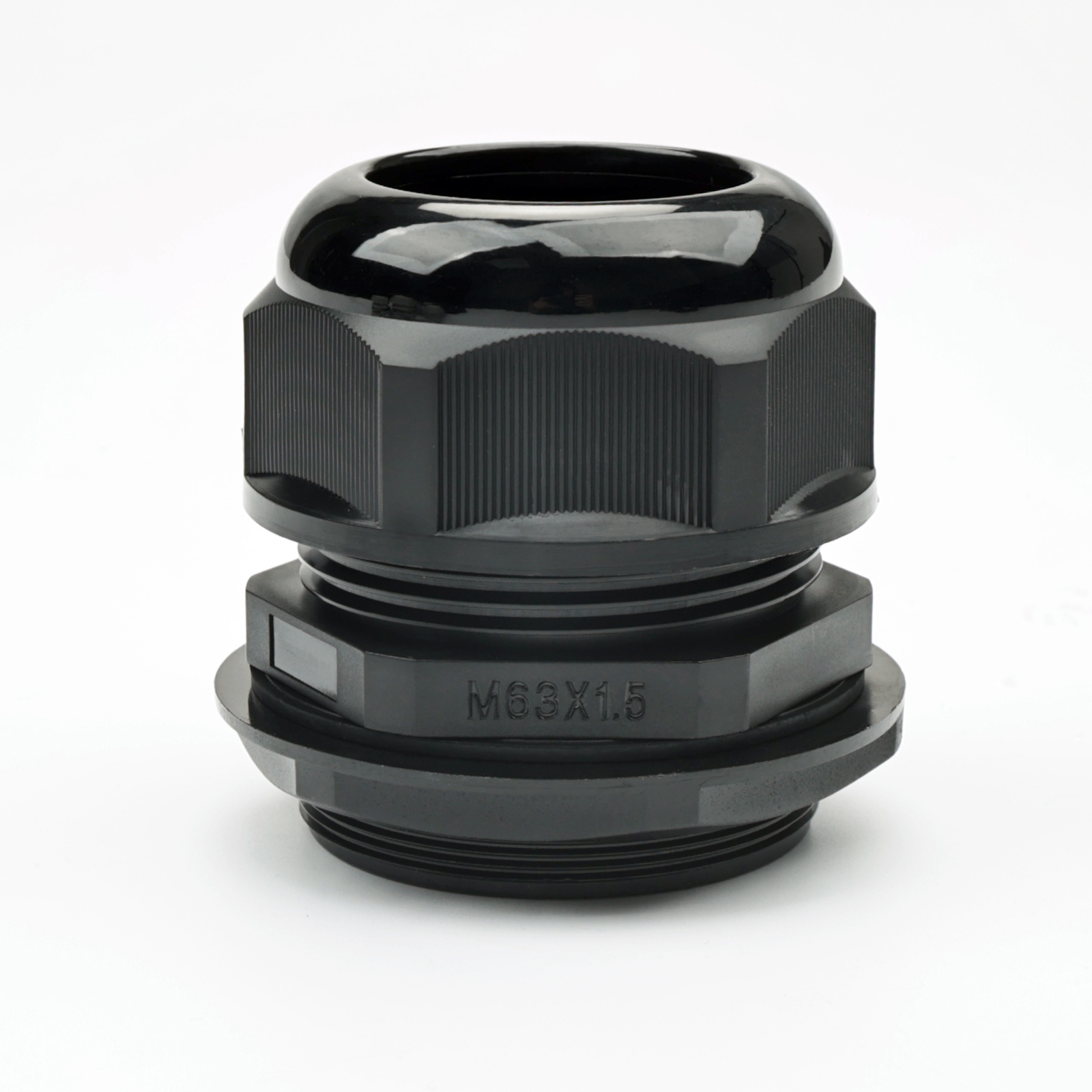
The upper end of the range: a large-size nylon cable gland, where claw geometry and seal thickness matter most for even compression.
Where the Claw-and-Seal Logic Matters Most
Industrial automation and control cabinets
Cabinet interiors combine vibration from nearby machinery with oil mist and coolant splash. The claw keeps cable movement away from the terminal rail, while the NBR seal resists grease and oil rather than absorbing them. Metric series glands are the usual choice here because enclosure knockouts are cut to metric threads.
Construction and outdoor infrastructure
Outdoor enclosures experience rain, temperature cycling and long static periods. The static rating of −40 °C to 100 °C is the relevant figure, because the cable does not move after commissioning; what changes is the jacket dimension as temperature shifts, and the seal has to keep contact pressure through that cycle.
Marine engineering and shipbuilding
Salt spray, salt fog and washdown put the chemical resistance of the PA66/NBR combination under continuous test. Salt spray, acid, alkali, alcohol, grease and solvent resistance all matter in this environment, and so does the claw: a cable that moves with the vessel is a cable that will work its seal loose unless it is mechanically anchored first.
New energy and outdoor power equipment
The same design rule — anchor first, seal second — appears in Gutai's project work outside the nylon gland range. For a coastal open-air EV charging project in Europe, 5,000 sets of IP68-grade metal waterproof connectors using a dual-seal anti-loosening structure were deployed after passing 1,000-hour salt spray testing and IEC 60068-2-6 vibration testing; the operator reported that connector-related electrical failures fell from 18% annually to 2.6%, and maintenance cost per station dropped from above 500 RMB to below 80 RMB. The materials differ from a nylon cable gland, but the sequence does not: the mechanical grip protects the seal, and the seal protects the connection.
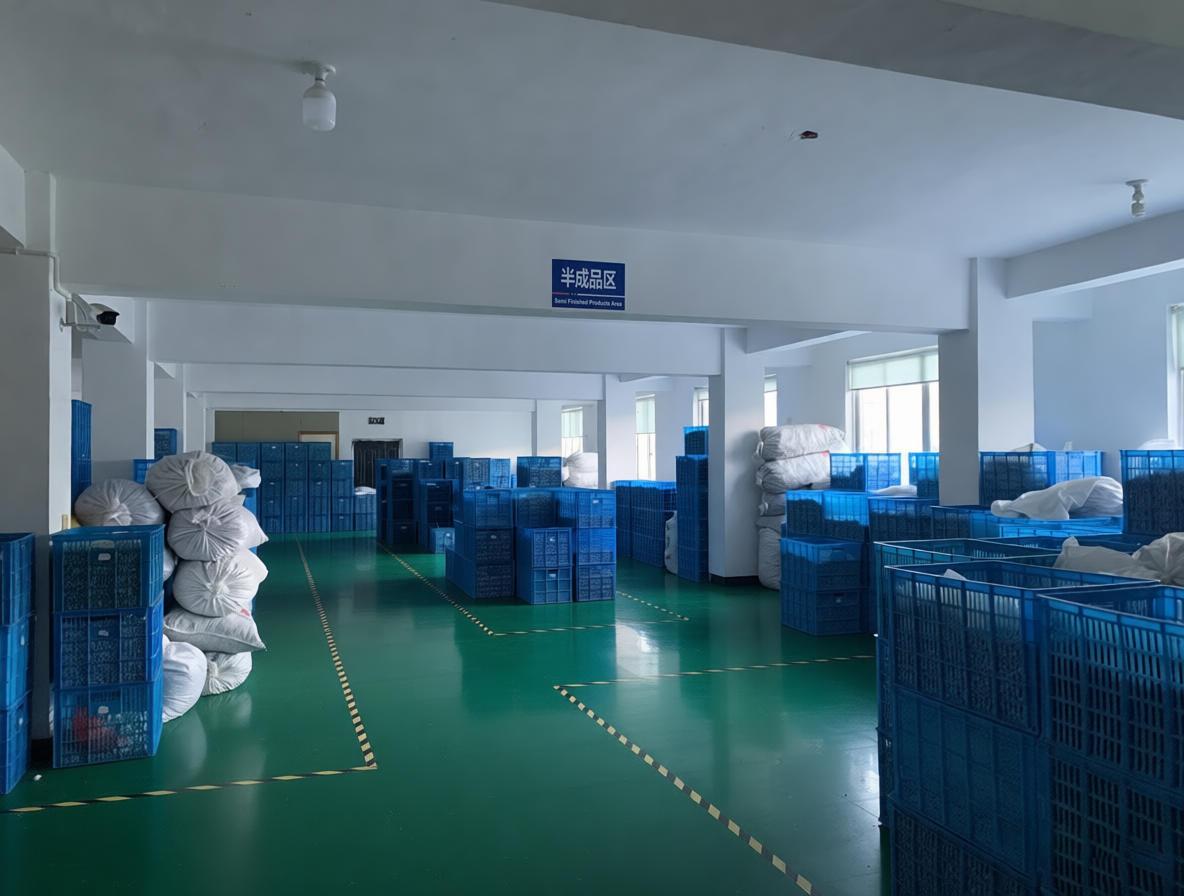
Semi-finished parts staged for inspection: claw and seal dimensions are checked before assembly, not after a leak is reported.
Comparison: Components, Specifications and Certifications
The table below separates what each component contributes, so that a leak can be traced to the part that actually failed rather than to the product family as a whole.
| Component | Material | Job in the assembly | Symptom if underspecified |
|---|---|---|---|
| Clamping claw | Moulded claw inside the PA66 sealing nut | Converts tightening torque into even radial grip; anchors the cable against pull-out and torsion | Cable slides, jacket abrades, seal works loose over time |
| Rubber seal | NBR (nitrile butadiene rubber) | Converts axial compression into radial sealing against the cable jacket | Weeping at the cable entry under spray or immersion |
| Gland body | Nylon PA66 | Enclosure thread, conical claw seat, seal seat, dielectric barrier | Thread strip, seat deformation, loss of compression |
| Enclosure interface | PA66 thread, 9–21 mm engagement | Transfers the seal from gland to enclosure wall | Water tracking through the port thread |
Series-level specifications are compared below. Both series share the same cable range and materials; the difference is the thread standard and the resulting outside diameters.
| Parameter | Metric series | PG series |
|---|---|---|
| Thread sizes | M12–M63 | PG7–PG48 |
| Cable range | 3–45 mm | 3–45 mm |
| Thread outside diameter | 12–63 mm | 12.5–59.3 mm |
| Thread length | 9–21 mm | 9–21 mm |
| Body / seal material | Nylon PA66 / NBR | Nylon PA66 / NBR |
| Applicable industries | New energy; industrial automation and advanced manufacturing; construction and infrastructure; marine engineering and shipbuilding | New energy; industrial automation and advanced manufacturing; construction and infrastructure; marine engineering and shipbuilding |
Certification scope is worth reading closely, because each document covers a defined product family rather than a general capability.
| Scheme | Reference | Issuer and reference number | Scope |
|---|---|---|---|
| CE | EN 62444:2013 | Dongguan True Safety Testing Co., Ltd., certificate TST20241202520-1SC, 12 December 2024 | Nylon cable glands, model M, series G, MG, PG, NPT |
| RoHS | EU RoHS Directive (EU) 2015/863 | SGS-CSTC Standards Technical Services (Ningbo) Co., Ltd., test report NGBEC26005747401, 13 July 2026 | Nylon cable gland |
| UL | UL 514B | UL Solutions Notice of Completion, File E539858, Volume 1, 13 September 2024 | Liquid-tight flexible cord fittings |
| ISO 9001 | GB/T 19001-2016 / ISO 9001:2015 | Beijing United Intelligence Certification Co., Ltd., registration No. 04324Q31620R0S, valid 2 July 2024 to 1 July 2027 | Production of cable waterproof joints |
REACH compliance and IP68 protection level testing are stated for Gutai's core products alongside CE and RoHS.
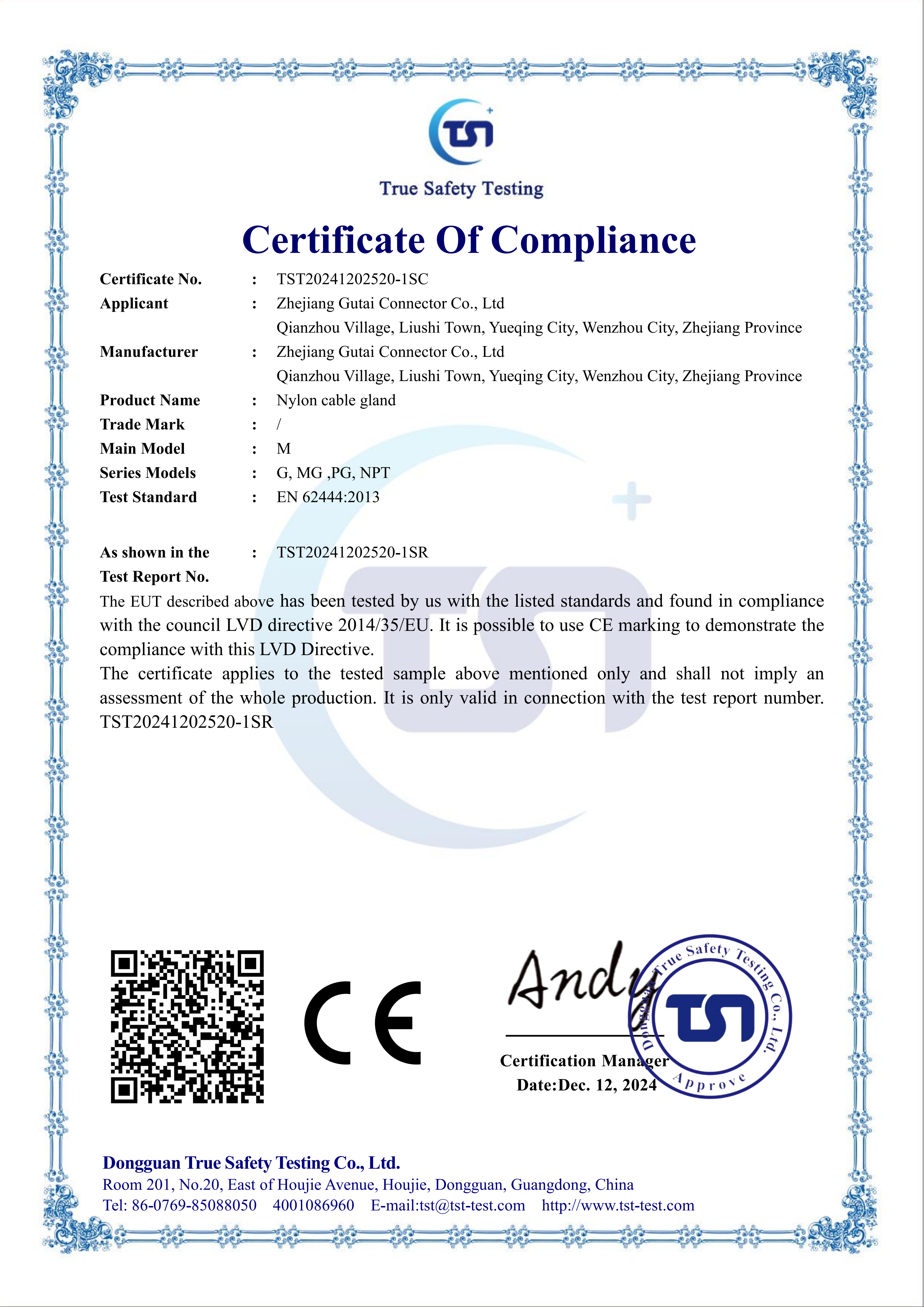
CE Certificate of Compliance TST20241202520-1SC, citing EN 62444:2013 for nylon cable glands.
FAQ
Which certifications apply to Gutai nylon cable glands?
Four documents apply to the nylon cable gland range. CE compliance is certified against EN 62444:2013 under certificate TST20241202520-1SC, issued on 12 December 2024 by Dongguan True Safety Testing Co., Ltd., covering nylon cable glands, model M, in the G, MG, PG and NPT series. RoHS compliance is supported by SGS test report NGBEC26005747401, issued on 13 July 2026 by SGS-CSTC Standards Technical Services (Ningbo) Co., Ltd. against EU RoHS Directive (EU) 2015/863. UL coverage is documented by a Notice of Completion from UL Solutions, File E539858, Volume 1, dated 13 September 2024, for liquid-tight flexible cord fittings under UL 514B. Quality management is certified to GB/T 19001-2016 / ISO 9001:2015 under registration No. 04324Q31620R0S, valid from 2 July 2024 to 1 July 2027. REACH compliance and IP68 protection level testing are additionally stated for the core product range.
Can the clamping range, thread and seal be customised for an OEM programme?
Yes. Gutai's stated customisation scope covers size and thread specifications, materials (nylon, brass and stainless steel), colour, packaging and OEM labelling, multi-hole layouts and specific seal customisations. Production combines mass manufacturing with OEM/ODM work, and product development is handled by a 10-engineer R&D team. Capacity is 500,000 pcs per month for cable glands and 100,000 sets per month for MC4 connectors, so customised runs sit alongside standard series production rather than replacing it. Thread standards available across the range include PG, Metric, NPT and G types.
What are the minimum order quantity, delivery terms and payment terms?
The minimum order quantity is 1 unit, and small trial orders are acceptable. Delivery terms are FOB or EXW. Payment terms are T/T, cash or Alipay. Acceptance criteria are defined as a pre-shipment test, which is the point at which dimensional and functional checks are confirmed before the goods leave the factory.
Can we validate samples before committing to a production order?
Yes. Small trial orders are accepted, and custom sampling services are available for buyers who need to confirm that a specific cable diameter seats correctly in a specific thread size. A practical sample evaluation covers four points: measure the jacket outside diameter and confirm it sits inside the working window of the chosen size, not at its edge; tighten the sealing nut by hand and then with a wrench to confirm the claw reaches a defined stop; pull the cable to confirm the jacket does not move under load; and inspect the seal after disassembly to confirm it has deformed evenly around the circumference rather than on one side only.
How is lead time set for a cable gland order?
Lead time is quoted based on your order quantities, so it is confirmed per order rather than published as a fixed figure. Because monthly cable gland capacity is 500,000 pcs, standard series orders are scheduled against existing production, while customised specifications — non-standard threads, alternative seal geometry, OEM labelling — are scheduled with the tooling and sampling step included. Sending the cable outside diameter, required thread standard and size, estimated quantity and target market at the enquiry stage allows the lead time and the certification documents to be confirmed in the same reply.
Next Step
If you are specifying a gland for a wet, marine or outdoor enclosure, the useful starting data is the cable jacket diameter, the thread standard and size, and the quantity. With those three inputs, Zhejiang Gutai Connector Co., Ltd. can confirm the matching claw and seal size, the applicable certificate for your market, and a lead time for the order.
Download the full product catalogue here: Gutai product catalogue (PDF). Product pages and the enquiry form are at gt-connector.com; written enquiries can be sent to vincy@gt-connector.com.
Conclusion: IP68 Is a Mechanism, Not a Label
The IP68 rating on a nylon cable gland is the outcome of a specific mechanical arrangement: a segmented claw that converts tightening torque into an even radial grip, an NBR seal that converts axial compression into a radial barrier, and a Nylon PA66 body that holds both under compression while providing the thread, the seat and the dielectric separation. Each part has one job, and the seal only holds because the claw has already removed movement from the system.
For buyers, that has three practical consequences. Specify against the measured cable jacket diameter and confirm it sits inside the working window of the thread size rather than at its boundary. Read certification scope rather than certification logos, because a CE certificate against EN 62444:2013 and a UL Notice of Completion under UL 514B cover different product families. And treat dimensional consistency as a sealing property: with a 3–45 mm range across M12–M63 and PG7–PG48 sizes, the difference between a dry joint and a weeping one is usually measured in fractions of a millimetre at the claw and the seal, which is why 100% full dimension inspection matters more here than in most accessory categories.
Zhejiang Gutai Connector Co., Ltd. manufactures these glands at Qianzhou Industrial Zone, Liushi Town, Yueqing City, Wenzhou, Zhejiang, China. The company was founded in 2019, operates a 5,000 m² facility with 80 employees, and exports approximately 80% of output to markets including the Middle East, Southeast Asia, India, Pakistan, the EU, the United Kingdom and the USA.
Have Questions or Need More Details?
Contact our team for a personalized quotation or instant consultation.
Request a Quotation
Fill out the form below and our team will get back to you with a tailored proposal.
WhatsApp Direct Chat
Prefer to chat in real-time? Message us on WhatsApp for instant assistance & quick answers.
- Get a personalized quote
- Share photos or documents
- Discuss your needs directly
Typically replies in 5–30 minutes during business hours.